
Key Takeaways
- Clean label formulations are now essential for brands, driven by regulations and consumer demand.
- Formulating with clean-label ingredients presents challenges, leading to a ‘trade-off triangle’ of Label Appeal, Performance, and Cost.
- Highly restrictive formulations focus on the cleanest labels but face flavor, color, and texture issues.
- Slightly restrictive formulations balance functionality and clean-label appeal, though they still carry higher costs.
- Minimally restrictive formulations offer full ingredient flexibility, optimizing taste and performance while managing label perceptions.

Clean label formulations are no longer a trend; they’re becoming much more than that. Consumers are increasingly looking for clean label ingredients in the products they choose every day.
Now, “cleaner” ingredients are a primary driver dictating current and future developments and a new standard for many brands.
It may be due to regulations, consumer sentiment, market positioning, or a combination of all of the above. Regardless of the reason, the need for cleaner labels is here, and developers are being forced to respond.
However, formulating with clean-label ingredients introduces a host of new constraints for companies to contend with.
The extent to which these affect clean-label formulations can vary greatly depending on each brand’s specific restrictions.
There is no “one-size-fits-all” solution. It ultimately depends on the company and its consumers’ priorities.
The Clean Label Ingredients Tradeoff Triangle
Whether projects are highly, slightly, or minimally restrictive, they face the same set of trade-offs.
These formulation constraints often boil down to three main factors, or the “trade-off triangle”, which includes: Label Appeal, Performance, and Cost.

After seeing where a clean-label formulation falls in each of these categories, it can be classified as Highly, Slightly, or Minimally Restrictive.
Now, let’s take a closer look at why someone would choose each of these, and the different advantages and challenges each presents, using ice cream as our example.
Highly Restrictive

Key Constraints
- No Added Flavors
- No Added Color
- Limited to No Stabilizers
Why take a Highly Restrictive Approach?
Products in the “highly restrictive” category often aim to offer the cleanest formulation possible, built on the simplest clean label ingredients.
It allows them to create a more “artisan” product that could resonate and be a differentiator for their target market. Brands seeking premium, niche, or boutique positioning are most likely to head in this direction.
While this approach may work well in small-batch kitchens or local shops, it can prove difficult when trying to reproduce it with industrial processing.
That is in addition to the higher costs and sometimes lower commercial availability of certain ingredients at scale.
The most common constraints these brands place on such products are no added flavors or colors, and limited to no stabilizers.
Flavor & Color Challenges With Clean Label Ingredients
Focusing specifically on ice cream, someone might think that a lack of added color or flavor is a minor issue.
In the case of cocoa or caramelized profiles, they may be asked to do a lot of the heavy lifting in both areas.
For fruit flavors, a high concentration of something like a strawberry puree would be called upon to do the same.
However, industrially processed purees are not going to carry the strong, distinct aroma and color that consumers might be looking for. And as for cocoa, it may handle color and certain profiles, but it can be highly limiting in what it offers in terms of flavor and visual appeal.
To combat this lack of impact, a company may choose to promote specific varietals or ingredient origins. This can help from a sensory standpoint, but even more so from a marketing one.
Still, this strength may quickly turn into a weakness if crop yields are low or, worse, if the featured ingredient crop fails. Even in the best-case scenario, a product could experience batch-to-batch variability in terms of flavor and color intensity.
The same goes for relying on cocoa, as developers will need to consistently source specific types of higher quality. And although the cocoa crisis that shook the industry in recent years may have subsided, the underlying issues remain.
This inconsistency is further magnified when coupled with the texture and performance issues present with these constraints.
Texture & Performance Issues

In addition to avoiding all flavors and colors, highly restrictive clean-label formulations often forgo most, if not all, stabilizers.
With the potential exception of some organic or natural starches, these developments rely on their sugar systems and processing (cook temp/time) as the primary control for texture.
Again, looking at ice cream, a lack of texture control may mean a base with lower freeze-thaw performance. This results in an icier, less creamy experience. A chocolate or fudge variegate might be too thin and bleed through the ice cream.
This is because stabilizers (like gums, pectin, or starches) thicken the water phase and bind free water in place. As a result, it helps the variegate maintain the proper viscosity to hold its swirl and prevents it from bleeding into the surrounding base. Without them, the water and solids aren’t held together, so gravity and density differences cause the mixture to separate. Water weeps out (syneresis), and heavier solids settle, breaking the uniform texture.
Yet despite these challenges, the target consumer may be willing to pay the premium simply for the label appeal alone.
But for those with different expectations, issues such as an icy mouthfeel, muted colors, or low flavor intensity might prevent a second purchase.
Slightly Restrictive Clean Label Ingredients
Key Constraints
- Natural Extracts Allowed
- Natural Color Allowed
- Clean Label Stabilizers
Why take a Slightly Restrictive Approach?
A slightly restrictive approach is the sweet spot for clean-label formulations.
It manages to balance the functionality required for a consistent, reliable product with the clean-label appeal consumers demand.
This is the category most companies seeking clean-label formulations fall under, and it is ideal for more mainstream brands.
Advantages and Tradeoffs of Clean Label Ingredients
The advantages of this path are numerous over the highly restricted approach.
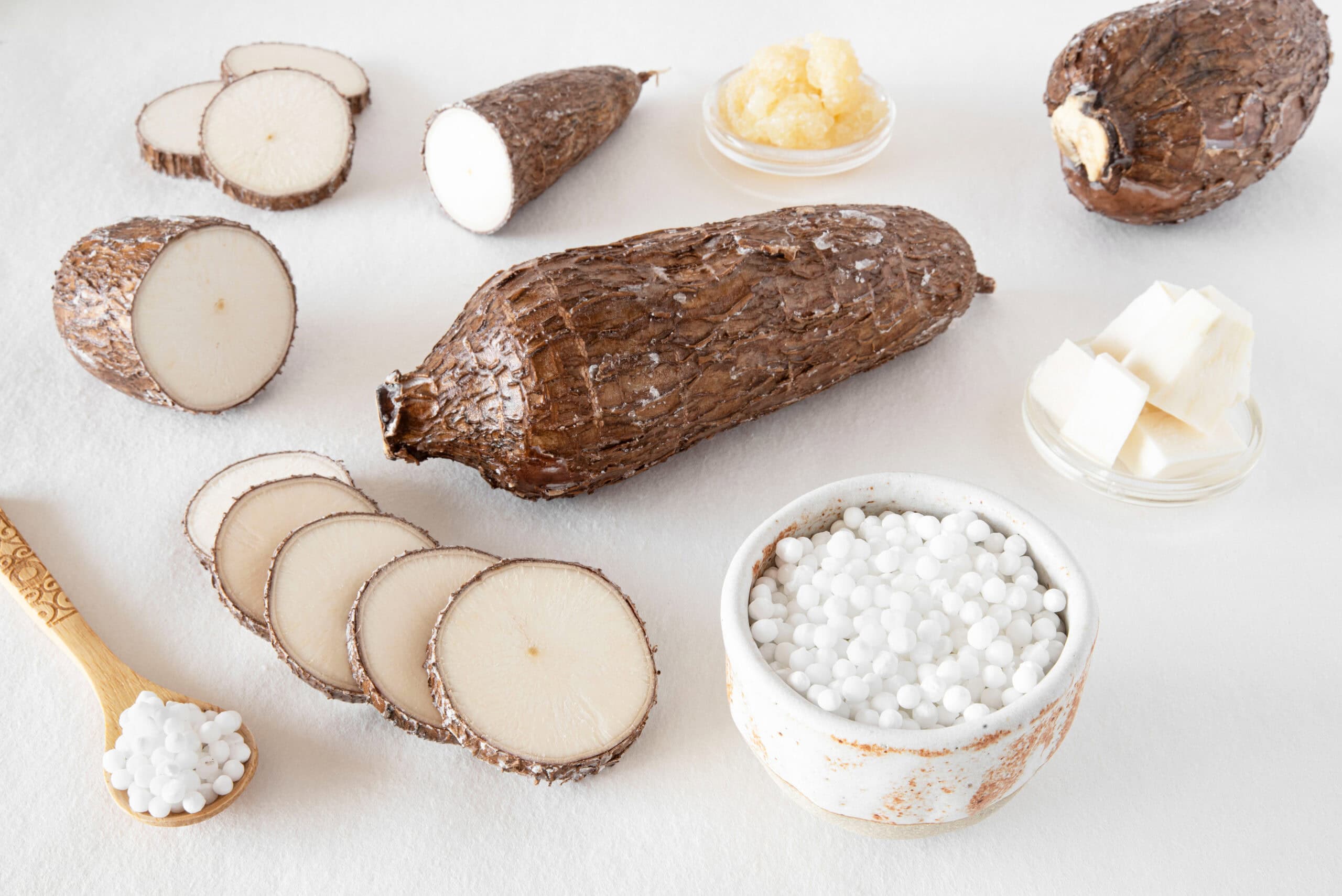
For starters, while some may still avoid natural flavors, ingredients like extracts and essences are back on the table. Additionally, components such as natural colors and clean-label emulsifiers and stabilizers, including starches, tapioca, and pectins, are available.
An expanded toolbox of clean label ingredients makes consistency a much easier target to hit.
Flavor, color, and texture are all enhanced with more consistent quality from batch to batch.
Improved viscosity control leads to mouthfeel in line with expectations and better inclusion integration.
Even with these apparent advantages, there are still trade-offs in clean-label formulations that utilize this approach
One of which is the cost.
As clean-label ingredients become increasingly mainstream and saturate store shelves, this may become less of an issue. But as of now, the higher cost of cleaner alternatives is somewhat unavoidable.
Then there is the fact that despite the improvements over the previous path, you still don’t have a full suite of tools available.
Not to mention, some ingredients might improve one aspect of sensory performance, but introduce issues in another. Natural colors derived from fruits or vegetables can improve color but may introduce unwanted off-notes. While it may not prevent a developer from using them, it could present another hurdle to overcome.
Minimally Restrictive

Key Constraints
- Natural Flavor & Color Compliance
Why take a Minimally Restrictive Approach?
Choosing a minimally restrictive approach unlocks the full toolbox of clean label ingredients and systems for optimal taste and performance.
It manages to boast consistent sensory quality, stability, and scalability, all at a cost-optimized price.
This may be an ideal choice for food service and retail, where the balance between high-performance and price is critical.
Even with the barriers that hampered the more restrictive routes removed, this road has its own set of trade-offs.
High Performance/Lower Label Appeal
With full functionality available, such as hydrocolloid systems, emulsifiers, preservatives, and flavor systems, these formulations can more easily deliver bolder flavor, creamier texture, more indulgent inclusions, and greater visual appeal.
Balancing price and performance at a level consumers expect can be critical for some brands to ensure success.
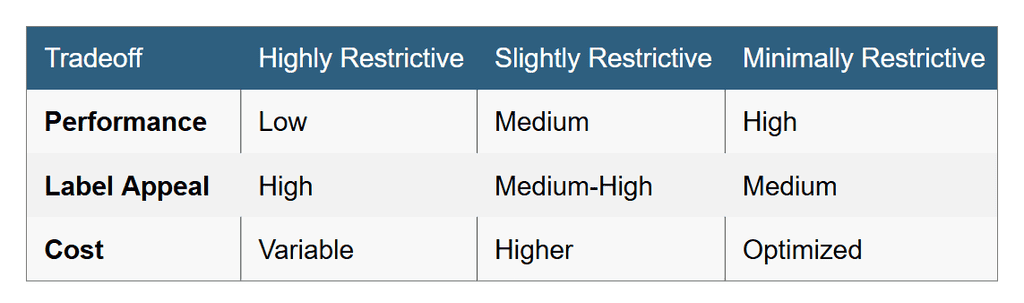
The chart above illustrates what each of these formulations could look like for a fudge variegate.
For some, the cost column may take precedence over having the absolute “cleanest” ingredients. However, for those consumers who prioritize even cleaner labels, a minimally restrictive formulation could pose potential perception issues.
On top of the fact that there is no blanket approach for developing clean-label formulations, the reality is that the line between these categories can be quite gray.
What might otherwise be a highly restrictive formulation might have the latitude to include a slightly less restrictive ingredient. The same could apply to a relatively minimally restrictive formulation that might still have certain components on its “no-go” list.
Balancing the trade-off triangle is not only about understanding the product and the brand, but also about understanding the target consumer. Ultimately, what are their expectations, and what are they willing to accept?
Striking the Balance with Clean Label Ingredients
In the end, as important as all this is, it’s finding the right partners that may end up making or breaking a product’s success.
Partners with the experience and know-how to get the most out of clean label ingredients and formulations.
Talk Through Your Clean Label Ingredients
Every formulation sits somewhere on the trade-off triangle. Tell us what you’re developing, and we’ll talk through where label appeal, performance, and cost can land.